
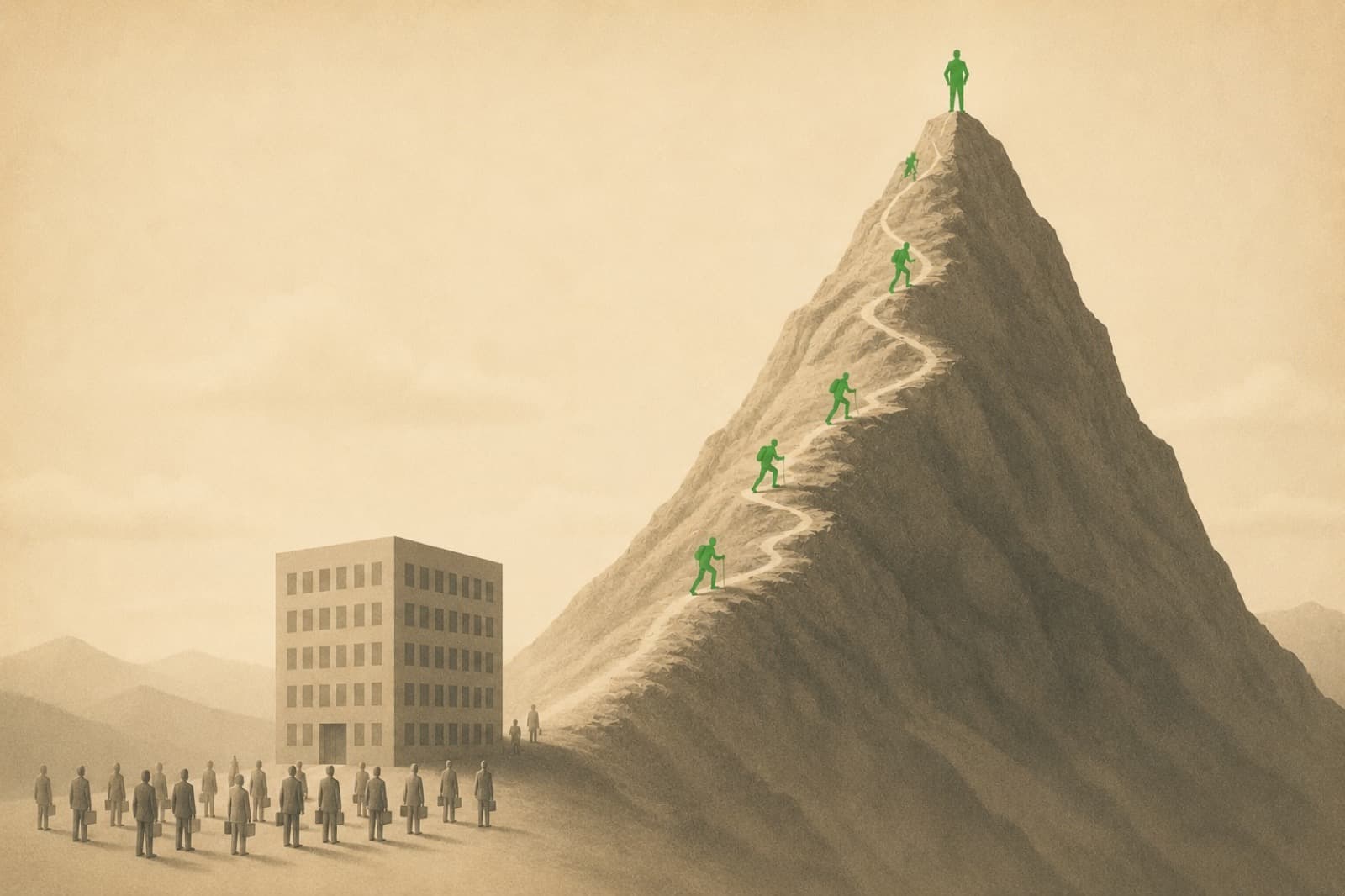
A few months ago, I was working with a large organization on documenting how generative AI could be used within their existing development process.
On paper, it looked like progress:
- multiple stakeholders involved
- structured reviews
- careful alignment
In reality, something felt off. The question wasn't: "How do we use AI to improve how we work?" It was: "How do we fit AI into how we already work?" That difference matters more than most people realize.
The real reason AI feels "slow" in enterprises
Many people assume employees don't understand AI, or the technology is not ready. What I have seen is different.
Large organizations are optimized for risk avoidance, consensus, and accountability. AI, on the other hand, thrives on experimentation, iteration, and fast feedback loops. When you try to combine the two without changing the system, friction is inevitable.
Reviews are not about quality
In the project I was involved in, even small updates went through multiple layers of review. At first, it felt excessive. Then it became clear: the goal wasn't just quality - it was shared responsibility. The more people review something, the less any single person is accountable, and the safer the decision feels.
Trade-offs were, of course, slower progress, diluted ownership, and resistance to change after approval.
Once something is approved, it becomes "fixed"
After several rounds of review, a document was approved and released. Later, I noticed a small improvement - removing a repeated sentence within a page. Simple, isn't it? But the response was: "This has already been reviewed thoroughly and approved."
The system prioritizes stability over continuous improvement.
Where AI actually gets lost
When AI is introduced into this kind of structure, it often becomes another step in the process, another layer to document, another output to review. There is no change in how decisions are made, or how the processes are structured. They don't think to use AI in changing them, either. AI becomes… administrative.
What this means for SME leaders
This is where you have a real advantage. You don't have 5 layers of approval, rigid process lock-in, or legacy systems protecting themselves. Which means you can choose differently.
1. Optimize for learning, not perfection
Instead of "Let's design the perfect AI workflow", start with "What can we test this week?" Small experiments beat perfect plans.
2. Keep ownership clear
If everyone owns it, no one owns it. For AI adoption: assign one owner, give them room to experiment, measure outcomes, not activity.
3. Treat outputs as temporary
Nothing should feel "final." If something improves: update it - don't wait for a formal cycle. AI works best when your system allows it to evolve.
4. Don't add AI into broken processes
Before introducing AI, ask: "Does this process actually make sense?" If not: simplify first, then layer AI on top.
Conclusion
AI is not failing in large organizations because the technology is weak. It is struggling because the system around it wasn't designed for speed or adaptation. As an SME leader, you are not burdened by that system. It is your edge - use it.
If you want to move from discussion to execution, that is exactly what I focus on at GetItDoneWith.AI. Because in the AI era, actions matter more than perfect structure.