
Recently, I joined a small, closed-door discussion with senior leaders involved in AI adoption at two very large technology companies — one Japanese, one American.
I can't share who was in the room or the details of what was discussed. But there was one question no one in the room could answer.
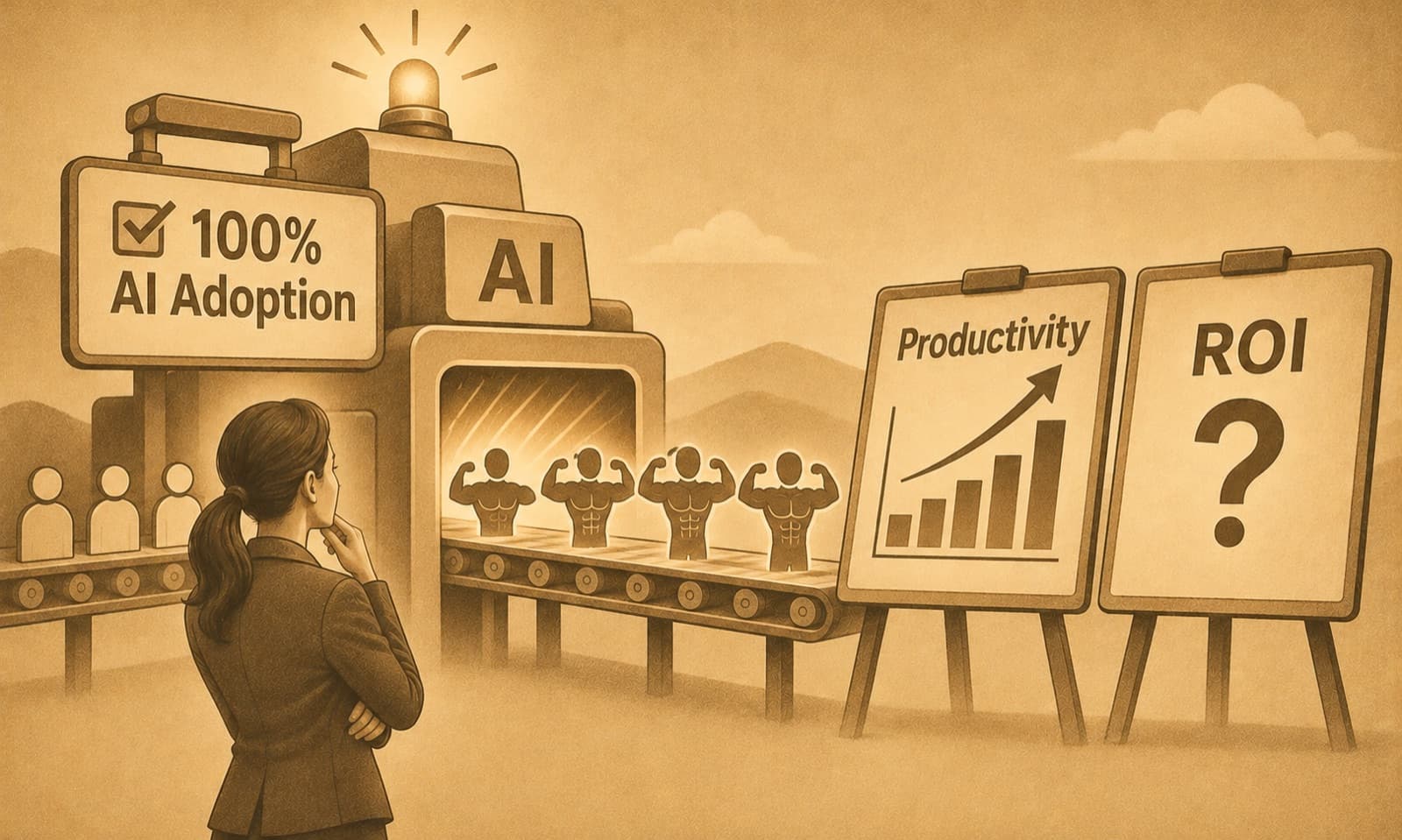
What is the ROI of AI adoption?
The Company That Achieved What Most Are Still Chasing
The Japanese organization had achieved something many companies are still struggling with: 100% of their employees had adopted AI. Not just experimenting — some were using agents shared across teams, others agents supporting their individual work. They were one of the early adopters of AI back in 2023, and they had been working to make AI useful to all their employees ever since.
But now management was asking the inevitable question.
"What is the ROI?"
They didn't have a good answer yet.
Why That Question Is Harder Than It Looks
Imagine AI allows an employee to accomplish significantly more in the same amount of time. Where does that additional productivity actually go?
If the same number of people remain in the organization, with broadly the same jobs, titles, salaries and structure, increased productivity doesn't automatically become financial return. Something has to happen: produce more, hire fewer, move people into higher-value work, improve quality or speed, reorganize.
Why This Is Particularly Complicated in Japan
This becomes particularly interesting in Japan, where large-scale workforce restructuring is considerably more difficult than in some other markets. One natural response is to reduce future hiring and reskill existing employees. Large Japanese companies may actually have an advantage here — many have decades of experience developing people internally and moving them through different functions.
But I keep wondering: what happens when the productivity gains become larger than the amount of useful work available for redeployment?
The End of Phase 1
I don't know the answer. What I do know is that getting everyone to use AI isn't the end of AI transformation. It may only be the end of Phase 1.
Once AI genuinely changes how much people can accomplish, the harder question begins: what are you going to change about the organization as a result?
AI adoption is partly a technology problem. Capturing AI's value is a management problem, and large companies are only beginning to face it.
Smaller Organizations Are Moving Faster
I work with both large enterprises and SMEs, and I consistently see larger impact in smaller organizations. They can move faster and capture AI's value more directly.
I'll keep watching for the large-company success stories, especially in Japan, but it seems to me that it is impossible to show significant change unless there is a drastic organizational change, which Japanese large companies would avoid at any cost.
If that's the case, how do you justify the ROI of AI adoption?
Technology and People Have to Be Looked at Together
Measuring the ROI of AI adoption is tricky, but one thing I am certain of is that we should always look at technology and human resources together.
Top decision makers, AI adoption professionals and technical professionals should always work together if AI adoption is going to deliver real ROI.
How are you measuring the ROI from AI adoption, and what is your next plan?